Synchrony
This semester, our ensemble created Synchrony, a collaborative composition set to Spring 1 by Max Richter. The work emerged through a process centered less on generating large amounts of choreography and more on refining small amounts of material through repetition, timing, and spatial organization. Much of the dance relied on minimal and repeatable movement vocabulary, which initially felt deceptively simple. Early in the process, I remember worrying that the material was too sparse or too restrained. Over time, however, that simplicity became one of the most important compositional choices we made. The more we revisited the movement, the more sensitive we became to spacing, proximity, alignment, and subtle shifts in timing. The dance gradually stopped feeling like a collection of phrases and began functioning more like a constantly changing spatial system.
Our process was heavily shaped by the structure and atmosphere of the music. The layered repetition within the music encouraged us to think less about dramatic movement invention and more about accumulation, suspension, and gradual transformation. Rather than matching every musical change literally, we often focused on sustaining movement through transitions or allowing one or two dancer’s timing to drift slightly against another’s or another pair’s. This created moments where the ensemble appeared unified and other moments where individual bodies emerged from the larger structure before dissolving back into it. Some of the most meaningful moments in the work came from these subtle shifts in relationship rather than from technically difficult movement.
One of the biggest discoveries of the process was realizing how much choreography can exist within spatial design itself. We spent a significant amount of time refining pathways, facings, distance between dancers, and the visual weight of different groupings in the room. At times, stillness became just as important as locomotion. A slight pause or delayed entrance could completely change the audience’s perception of tension or attention. Because the movement material remained relatively minimal throughout the work, even small compositional adjustments became highly visible. This forced us to become much more intentional about how the audience’s eye moved through the space. I found eye contact to my collaborators also vital to the effectiveness of the piece, being aware of the other bodies I was occupying the space with allowed for specificity in the shaping of the room.
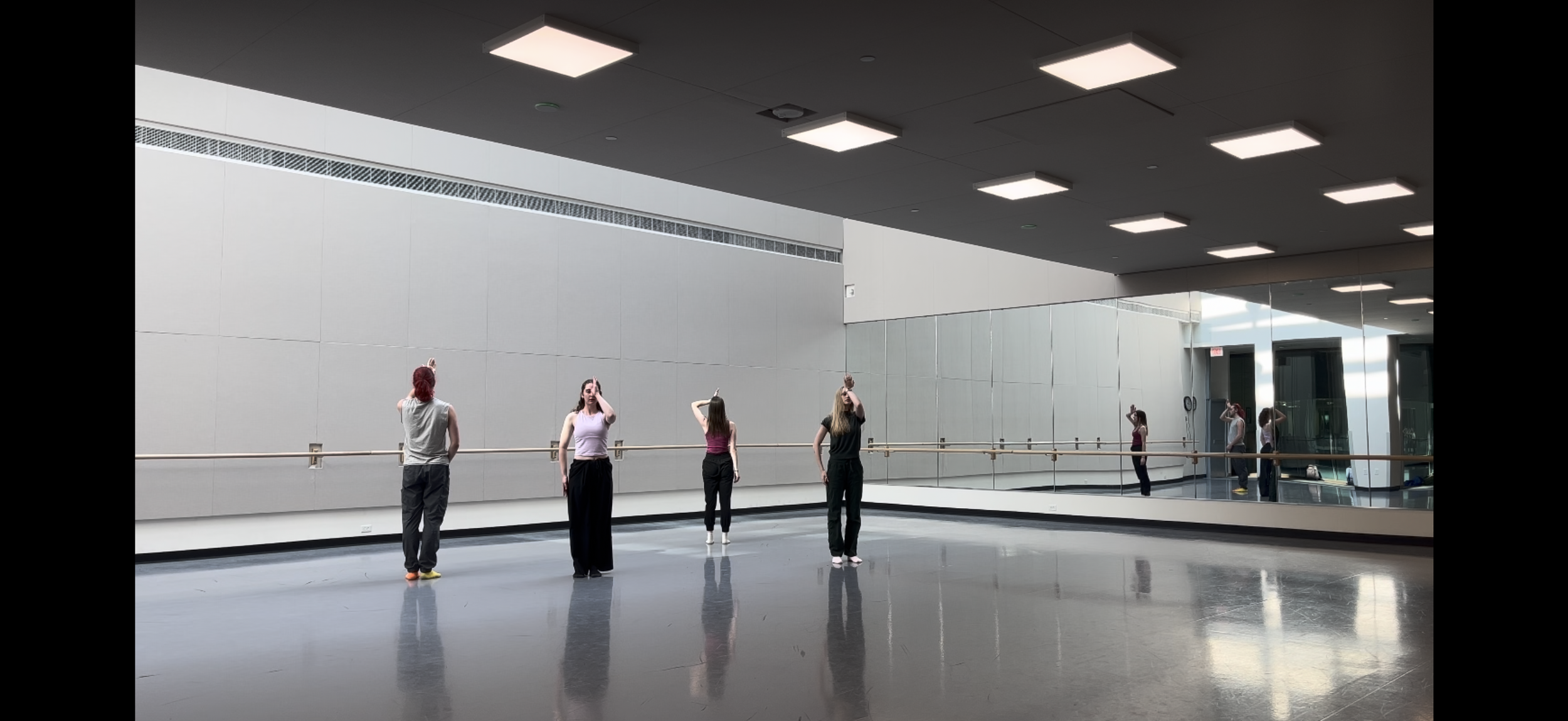
Collaboration also became much more complex and meaningful to me through this project. Before this semester, I often thought of collaboration primarily as dividing responsibilities evenly or combining individual ideas together. Through this process, collaboration became much more embodied and relational. It required listening physically as much as verbally. Timing, spacing, and awareness of one another’s presence became forms of communication. Since our work depended so heavily on ensemble precision and shared attention, trust became essential. We had to constantly negotiate differences in interpretation, pacing, and visual priorities while still maintaining a cohesive structure.
Our collaborative process was rarely linear. Many rehearsals involved experimenting with simple tasks, revisiting material we thought we had already settled, and gradually refining details over time. Some sections of the dance changed significantly through feedback and revision, while others remained surprisingly close to our earliest drafts. Looking back at rehearsal footage from earlier in the process, I can see how much clearer and more intentional the work eventually became. The earlier versions often contained the same core ideas, but the relationships between dancers felt less defined and the spatial structure felt less precise. Revision was not about replacing the material entirely, but about deepening our understanding of it.
Throughout the semester, my understanding of choreography shifted away from thinking primarily about movement generation and toward thinking more architecturally about composition. I became increasingly aware of choreography as a system of relationships involving time, space, rhythm, attention, and perception. This course made me more conscious of how audiences experience pacing, repetition, density, and visual focus. I also became more aware of some of my own compositional habits. I tend to want to add complexity quickly, either through movement vocabulary or structural layering. This process challenged me to remain with an idea longer and trust that repetition itself could generate complexity when approached with enough specificity and attention.
I think this project also deepened my understanding of how bodies communicate collectively. Ensemble work requires constant negotiation between individuality and cohesion. There were moments in Synchrony where the dancers functioned almost as a single organism and other moments where individuality became more visible within the larger structure. That tension became one of the most interesting aspects of the work for me. The dance asked us to remain deeply aware of one another while also maintaining our own physical specificity and presence.