Study 1: Formal Devices
Zoe
This study began as a small dance: a question about accent and gravity. I was interested in where movement actually begins, not where it looks like it begins, but where it originates in the body. Does the accent come from breath? From weight dropping? From the pelvis? From the hands once the torso has already decided?
Early on, the material lived in accumulation and retrograde. I repeated phrases, translated movement from torso to hands, and played with horizontal and vertical planes. The world felt interior and process-driven, more concerned with sensation than spectacle.
You can see an early shaping of that material in the following rehearsal clip:
Refusing to Run
Repetition clarified the choreography rather than flattening it. The more I repeated, the more I could feel subtle shifts in timing and gravity. Pauses became structural, not emotional. I began to trust that stillness could hold as much weight as motion.
Originally, I added music to deepen the world, a process no one witnessed. But when I shifted to the finished song, the work was deeper than I originally thought possible. The music introduced urgency, propulsion, and a sense of forward pressure. Instead of adjusting the choreography to match that intensity, I kept the movement committed to its internal logic. The friction between the sound and the body became the study.
In the final performance, I introduced a full bag placed in the space, one I never acknowledge or touch. The bag changed everything. Suddenly the dance no longer existed in abstraction. A full bag implies a tie to what’s real, mobility, the lack of ability of departure. Combined with the driving track, it suggests that something should be happening. In the world, someone should be leaving. Moving. Acting.
But the body stays.
That refusal, or perhaps inability, became the central tension of the work.
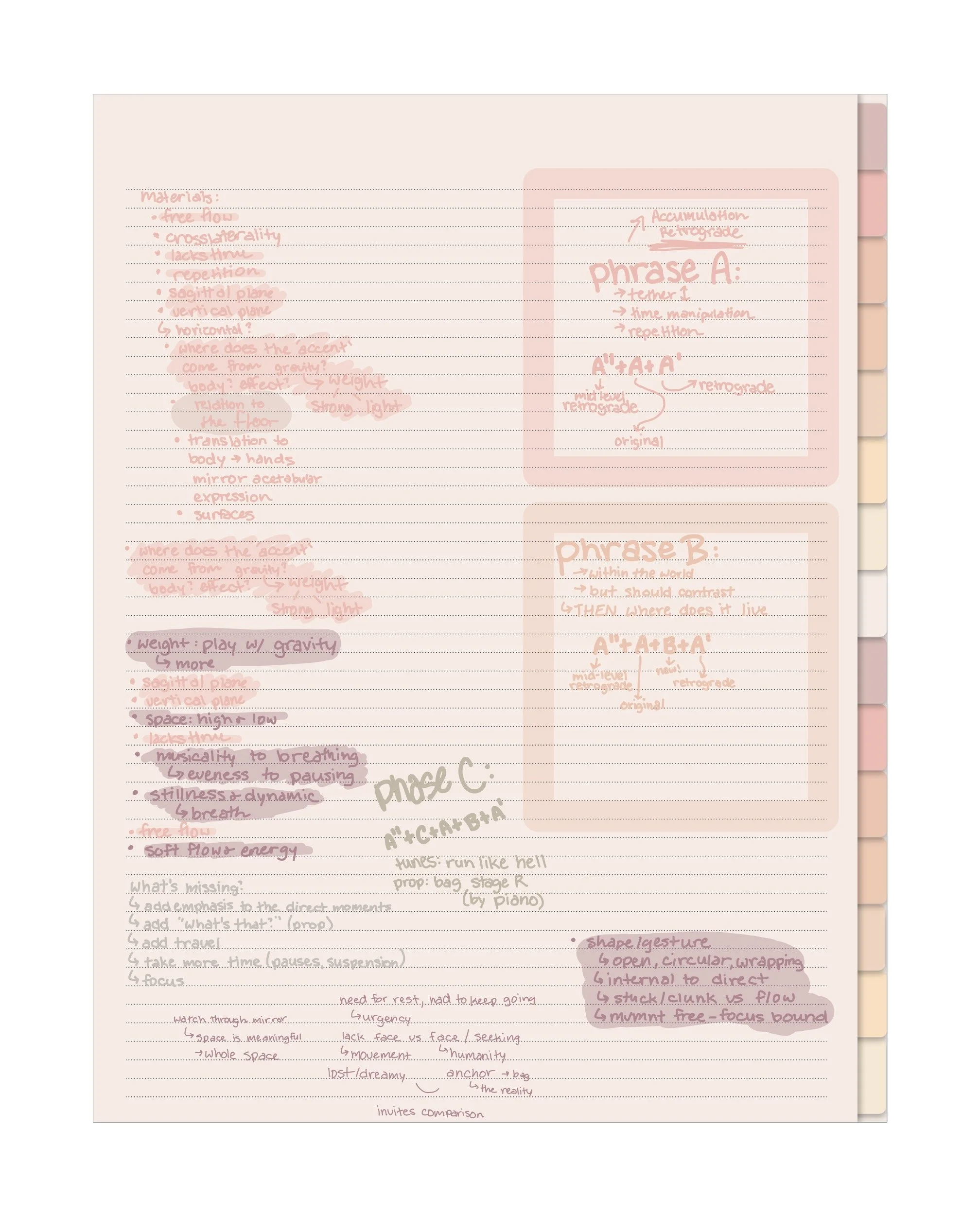
Here is a page from my notebook mapping the structural logic of Phrases A, and its subsequent primes, B, and C, along with notes about gravity, planes, repetition, and what the world might still be missing:
I wrote: What’s missing? Add emphasis to the direct moments. Add travel. Add focus. The bag ultimately became an anchor, a piece of reality sitting inside a world of internal processing. It invited comparison without demanding narrative.
Final Rehearsal
First Brainstorm
Peer feedback pushed me to consider clarity and stakes. I’ve included a blurred image of those notes, intentionally obscured, because the work itself became about partial information and unresolved action.
One consistent observation was that my choreography tends toward interiority. I had to decide whether to challenge that instinct or place it in opposition to something louder. I chose the latter. Rather than making the movement more dramatic, I intensified the environment around it.
What surprised me most is how much tension can accumulate through non-action. The music insists. The bag waits. The body reorganizes, pauses, repeats, negotiates gravity. The audience begins to ask: Why isn’t she leaving? Does she know? Is she refusing? Is she stuck?
The dancing right now is teaching me about commitment, about staying inside a choreographic logic even when external forces suggest otherwise. It’s also teaching me that context can generate stakes without additional steps.
Next, I want to push this further by experimenting with spatial placement of the bag and by investigating whether Phrase C introduces decision, stillness, or even more delay. I’m curious how long tension can sustain without resolution. I’m also playing with the idea of truly discovering what the addition of more formal devices could look like.
What happens when everything says “run,” but the body remains?
That’s the question I’m still dancing with.